
Gems from Melissa Cash (Co-founder and CEO at Pok Pok) and Phil Carter (Founder and CEO at Elemental Growth / Subversive Podcast) in The Anti-Addictive Playbook Behind Pok Pok’s 9X Subscriber Growth | Melissa Cash and from Felix Boudreau (previously Head of Growth at Pok Pok) and Peggy Anne Salz in How Pok Pok Builds Brands Parents Trust
Hi, fellow growth practitioner!
This week, I’m bringing you insights on Influencer/Creator Marketing, Branding, and Retention.
🥇 TOP GEM OF THE WEEK
I’ve been following Pok Pok for a while because I find their positioning and growth strategy interesting.
Hearing insights from their CEO, Melissa, gave good perspective on what they’ve been doing.
Hope you enjoy these gems as well!
🤝 FRIENDS OF GROWTH GEMS
I’ve been using screensdesign for 1.5 years now.
Some things I liked from the start is that they include video onboardings allowing me to really get a sense for the UX and their revenue filter/sorting.
But it was time-consuming to find what I was looking for unless I had a specific app in mind.
With the screensdesign MCP, your favorite LLM can do that work using their library 👏
Bonus: it even has review analytics across countries, which is great for user research!

💎 Luck and serendipitous moments (app store awards, celebrity mentions, influencer posts) only provide meaningful boosts if your product fundamentals are already solid. Obsess over growth and retention internally so that when a big moment comes, your product is ready to capitalize on it.
(16:11)
💎 Resist the temptation of growth hacks that conflict with your core values. Skipping tactics like intrusive popups may slow short-term growth, but it preserves the user trust that compounds into higher long-term retention and LTV.
(18:49)
Melissa gave the example of the play kit parents can opt-in to receive, and the company decision not to get that opt-in via a pop-up in the app.
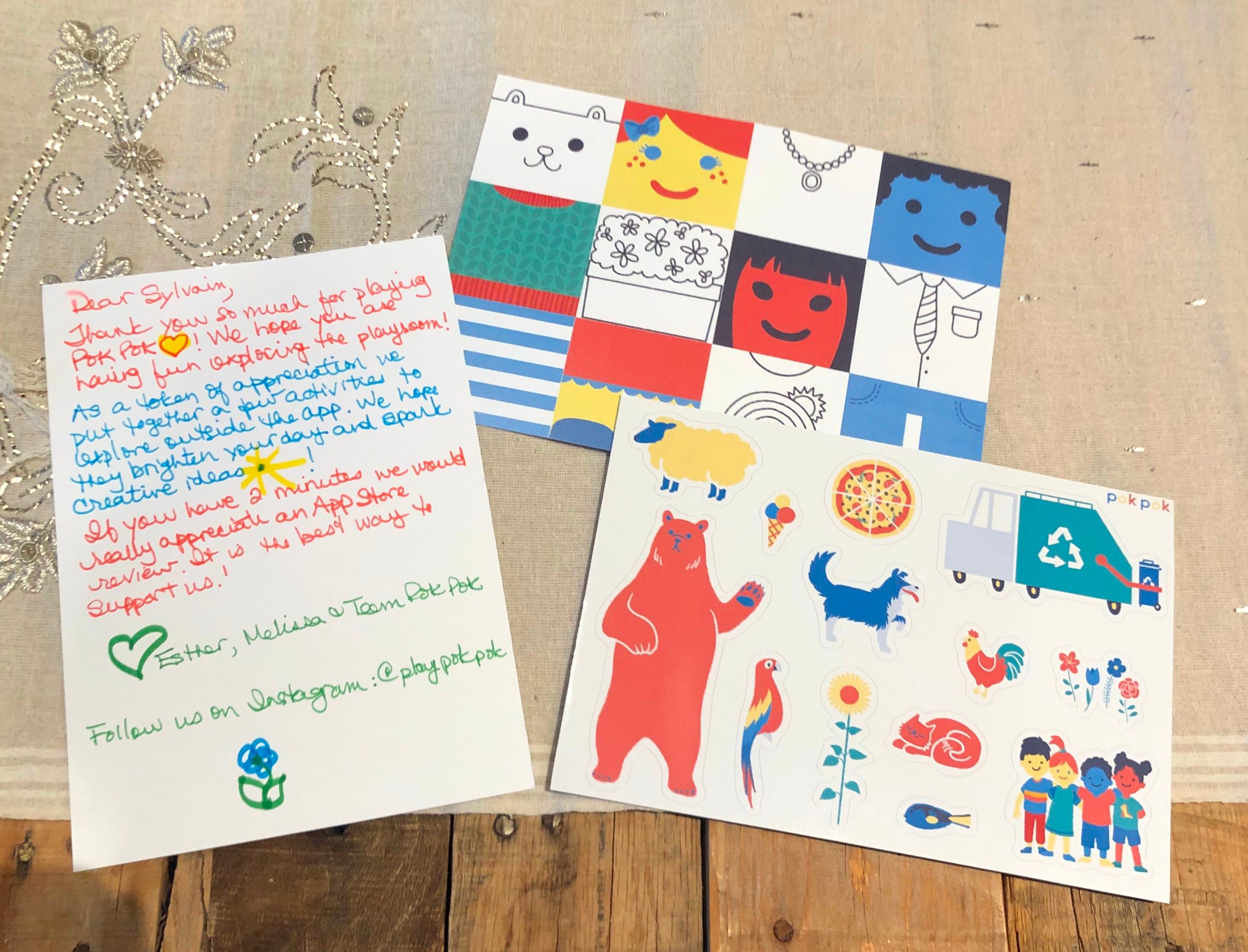
💎 People might not care about your unique differentiators that much. What matters is the positive associations your positioning triggers, so test customer-language positioning discovered in reviews rather than the internal jargon you think is unique. Example: Pok Pok initially focused on being open-ended and creative-led, but nobody cared. They then switched to Montessori-inspired and it was a huge unlock.
(23:20)
I thought this was such a great point.
Melissa shared that probably only half of their customers really understand what Montessori means but they associate it with good/private/expensive education and creativity/independence. This was a good match so they went with it, but are now moving a bit away from it.
What is your “magic word”?
Read more on their creative strategy in the edition below👇

💎 Shift from traditional influencer marketing to a portfolio of micro-creators chosen for content quality rather than follower count. Pay per-video with performance bonuses tied to engagement so your downside is limited and winners are rewarded.
(28:03)
A lot of their creators have only 2,000 followers, but they’re real parents.
Below a few accounts if you’re curious:
As you can tell, posts are much broader than Pok Pok’s scope and relatable to moms in general.
💎 Treat your micro-creator program as a content engine: repurpose your best-performing creator content as paid ad creative.
(29:02)
Classic. You might also be surprised by what transfers or not from time to time!
💎 Fast paid growth on Meta can bring in the wrong users who churn quickly. Be mindful of who each channel acquires and prioritize channels that bring the higher-retaining, higher-LTV customers even if volume is slower.
(30:41)
💎 Don’t neglect brand marketing just because it’s hard to measure. Like retention and word of mouth, brand investment compounds over time and becomes a durable growth moat that performance marketing alone can’t provide.
(30:54)
Melissa later advised investing in brand (both company and founder personal brand) earlier than feels comfortable.
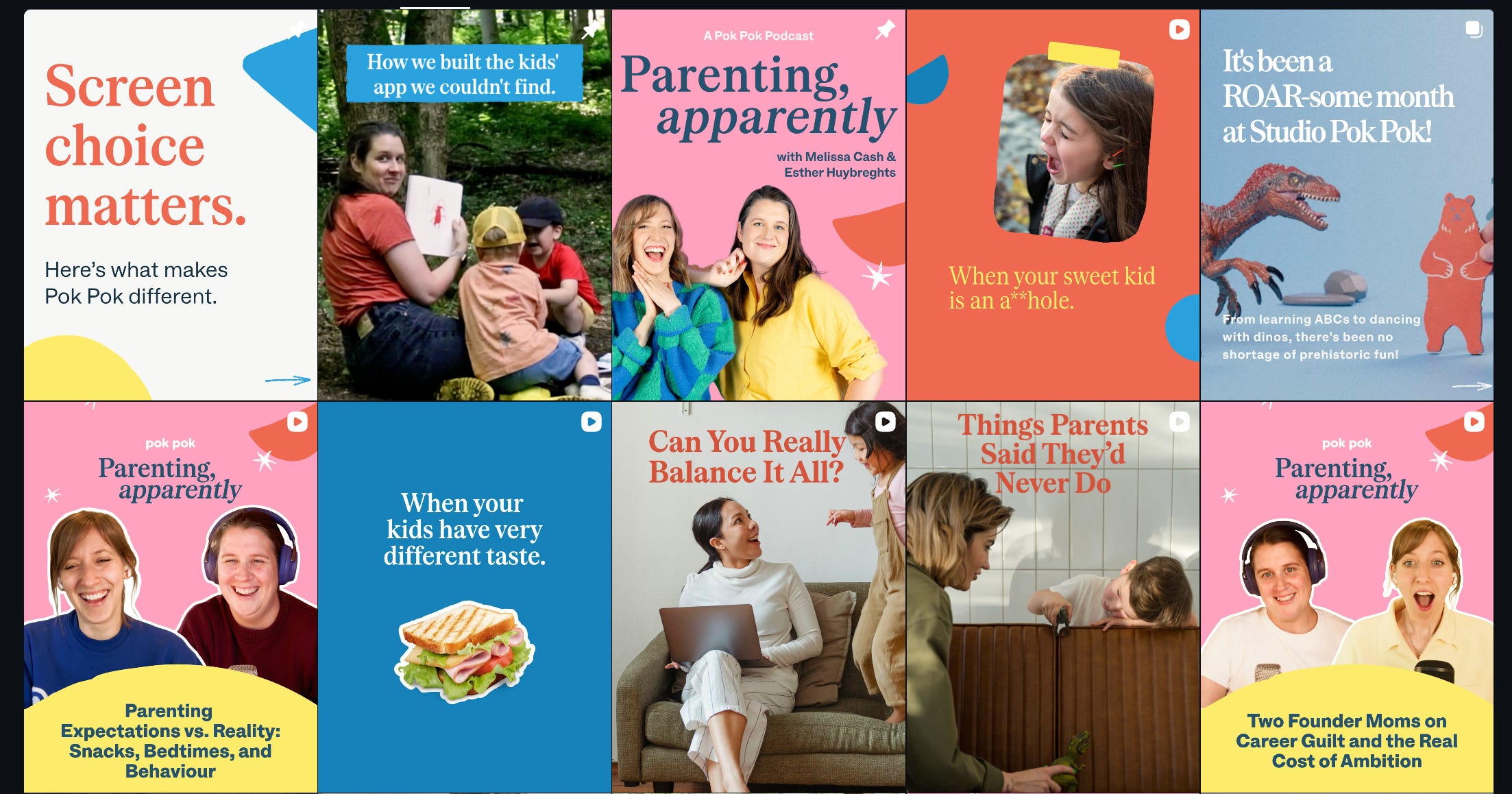
Pok Pok created a brand department to lead the “top of funnel” conversation around all the things that are important to Pok Pok. One thing that reflects this is their Instagram account:
They also recently did a partnership with Calm (cf. here and here):
💎 Don’t “spray and pray” when sourcing creators. Look for creators that make great content across diverse types. Then start working with them and be quick to decide on who to truly form a relationship with or not. Example: for Pok Pok it could be anything from like the Montessori homeschooling mom to a crunchy mom or someone that does day in the lives.
(31:55)
💎 Don’t over-direct your creators with rigid scripts and mandatory talking points; it reads as disingenuous. Give them the product, let them get to know it, and trust them to position it authentically for their own audience.
(33:45)
It can also be a time-saver if you’re low on bandwidth.
Where I would counter that is when you find top-performing formats, in which case giving specific direction to get “iterations” is worth it.
💎 Structure creator partnerships with a trial period and clear viewership thresholds. Start with a batch (around 20), expect roughly four or five hits, but still give creators a few weeks because it often takes time for them to learn how to position a unique product.
(34:58)
They give people a 1-month trial where they create 1 video a month, then decide to continue or not.
Melissa said it’s very rare for Pok Pok to see a video go viral in a week.
💎 Delay launching on Android until you’ve nailed unit economics and product-market fit on your first platform. Maintaining two apps early splits focus and lives in your brain rent-free; single-platform focus in the early days saves money and mental capacity.
(39:28)
She did mention that for Pok Pok specifically, Android has helped their retention because families have or buy a cheap Android tablet (or Kindle fire). In that category, you can’t stop at which OS the user is acquired on. They had a lot of requests from customers before they added the platform.
💎 Never treat your price as final. Underpricing early out of fear of alienating adopters is a common mistake; it’s always easier to lower price than raise it, so start higher and continuously test price, market by market.
(42:47)
She quoted Patrick Campbell (prev. ProfitWell, sold to Paddle): “if you don’t change your price every year, you’re living wrong”.
More insights from Patrick below 👇

💎 When the buyer isn’t the daily user, assume they may never re-engage with your product after purchase. Frontload value communication and trust-building during onboarding and use offline touchpoints (like a physical kit) to keep your product top of mind.
(44:30)
They are still investing a lot in their “Grownup area” in the app, for that reason.
More about their playkit here:
💎 Make lifecycle marketing add genuine value rather than generic updates. Instead of ‘your kid made a thing,’ show progress and meaning (like skill evolution over six months, particularly through comparison) so each message earns the 30 seconds of attention and reminds the buyer why they subscribe.
(50:46)

I’ve featured gems from Felix several times, and this is a good occasion to add a few more from him on Pok Pok’s growth strategy.
💎 When the user and the buyer are different people, skip freemium and go straight to a free trial. Freemium forces you to add locked content and pop-up paywalls, which works for an adult in a health and fitness app but breaks the experience for a kid who doesn’t understand what a paywall is. Pok Pok runs a clean free trial model (monthly and yearly SKUs) with no free tier at all.
(01:31)
💎 Choosing a trial-only model has an acquisition cost: expect less word of mouth, fewer downloads, and fewer reviews than a free tier would generate. Plan for paid ads to carry a bigger share of acquisition, and budget for creative and user research accordingly, since the organic flywheel will be weaker.
(02:28)
This is your sign to read the edition below 👇
💎 Should you have a hard paywall?

I’m baaack! I told you it wasn’t a strike. If you’re curious, here is what to expect from me moving forward.
💎 With a small UA team, stay focused on a few channels instead of chasing a broad media mix too early. Each channel needs its own creative and analytics, and channels don’t stay steady forever; when several break at once, a thin team burns out and results suffer. Pok Pok keeps Meta as its core channel and explores Google Ads, DSPs, ASA, and influencers around it.
(04:37)
This reminded me of a quote I recently saw from Hannah Parvaz (Founder at Aperture) in Growth Gems #117.

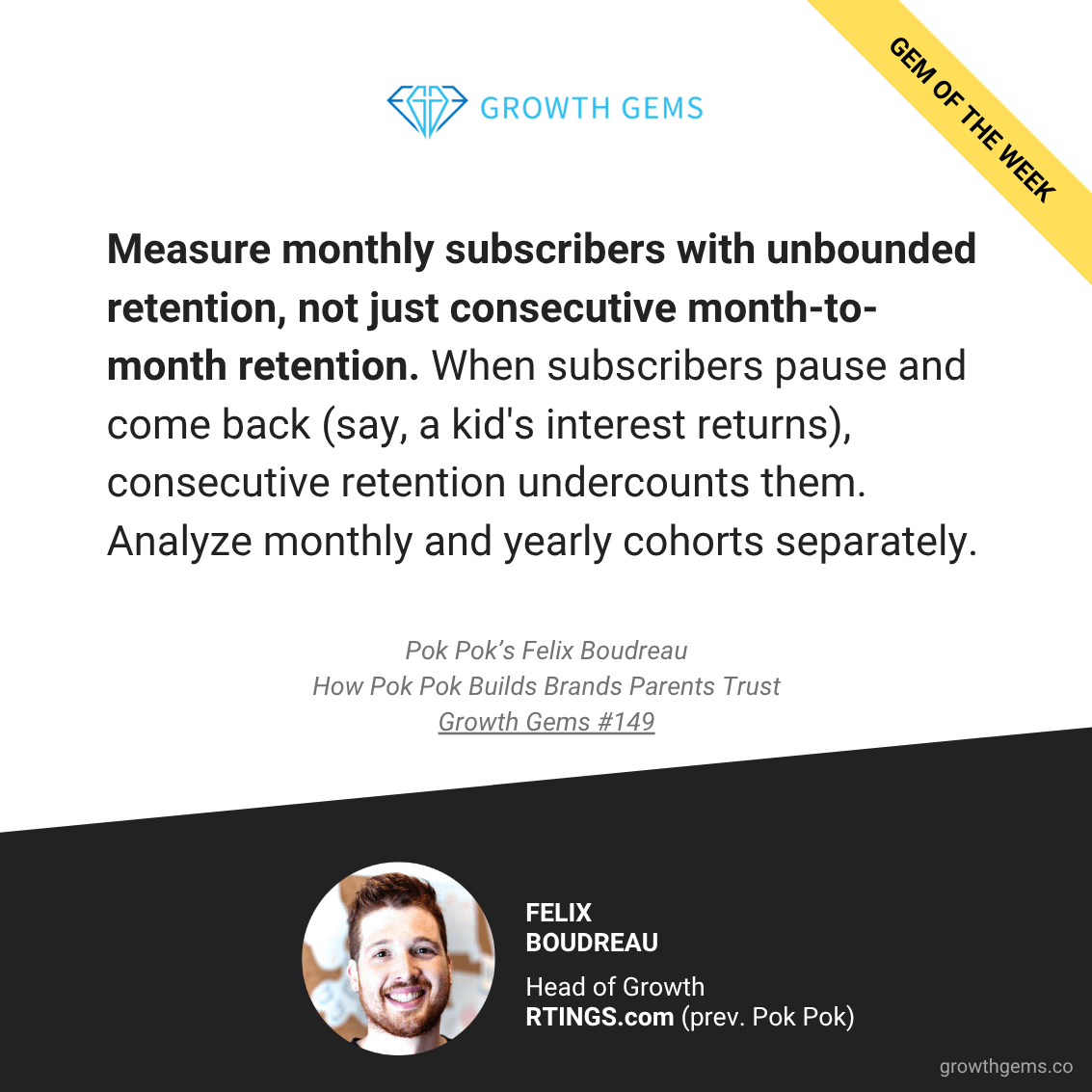
💎 Measure monthly subscribers with unbounded retention, not just consecutive month-to-month retention. Many monthly subscribers stay a couple of months, pause for a couple of months, then come back, for example when a kid’s interest shifts and later returns. Strict consecutive retention undercounts their value, so analyze monthly and yearly cohorts separately and account for returning users.
(08:02)
That’s a good one. With LLMs, no excuse not to look at it!
💎 In kids’ apps, license or resurrect nostalgic IP that the parent remembers, even if the child has never heard of it. The parent is the buyer, and “I used to have that as a kid, so I want my kid to have it” is a strong purchase driver. It doesn’t have to be a trendy brand like Bluey; old IP (even from video game archives) can work. Example: Flintstones vitamins still sell at the pharmacy even though today’s kids don’t know who the Flintstones are.
(08:08)
I also saw a similar thing mentioned in a recent FunnelFox webinar.
💎 Judge rising CPIs against your revenue per download, not in isolation. If you now extract more revenue from each download, a higher cost per download can be perfectly healthy. Offset the rest with organic and community channels where you don’t pay as much, and evaluate acquisition on a blended basis.
(12:36)
No brainer. I recommend an analysis of this both over time and at the creative-level.
See you next time.
Stay curious!
- Sylvain
Head of Growth / Consultant
Follow me on LinkedIn
🔗 Sources:
the micro-creator setup with per-video pay is smart. curious why the bonus is tied to engagement and not subs, is it because attributing subs to a single creator is too fuzzy?