
Gems from
Anastasiia Avramenko (Head of marketing & growth at Calm Studios) on the Growth by Design Podcast 20K → 16M Installs | TikTok Mobile Growth Secrets
Phil Carter (CEO at Elemental Growth) on the Sub Club Podcast by Revenue Cat, The AI Growth Playbook for Subscription Apps.
Hello, fellow growth practitioner!
This week, guest miner David Vargas (Independent App Growth Consultant) is bringing you insights on an issue that is becoming more and more popular in today’s market: The difficulty of finding growth viability and scalability in Meta due to the huge competition caused by vibe-coded apps and how TikTok can be a great alternative for many of these apps.
🥇 TOP GEM OF THE WEEK

SPONSORED INSIGHT & RESOURCE
I don’t believe in disrupting roadmap priorities to test the latest tool (or app2web!): “let’s see if it works” is rarely a good enough reason.
But based on my experience, Botsi’s promise to “show the right price & paywall to each user” just makes so much sense.
So you owe it to yourself and the company you work with to do the math for the potential impact it might have.
That’s what Botsi’s Opportunity Assessment is for. You share a sample of anonymous subscriber data (you can hash user_id), answer a few questions about your app, and their AI/ML models come back with your predicted LTV lift from per-user pricing. No SDK, no code changes.
About 10 minutes on your end, results in 3 to 5 business days, and they walk you through the numbers on a call. Works alongside RevenueCat, Adapty, Superwall, or your internal tech.

TikTok is not a new channel anymore and yet, many people treat this ad network as an alternative to Meta and Google Ads when in fact, it has its own functioning and consumer behavior.
Below, I’ve selected the best advice from an episode of Growth by Design, a by Applica, where Anastasiia shared the successful story she had with TikTok Ads, using low budgets while working on the organic side as well, resulting in an incredible growth trajectory passing from 20,000 installs to +16M with under $5k/month budget of total spend.
💎 When testing a new channel, let the data lead you even if you are not a native user of that platform. A $50/day TikTok test revealed a 5x lower CPI than Meta, which justified a deep investment in learning the platform's language, formats, and audience behaviors from scratch.
(06:12) by Anastasiia
This is a situation that I have seen when testing TikTok, but in both directions: Sometimes it performs at a level that Meta can’t match and other times, TikTok can give a 20x higher CPI than Meta or Google Ads.
And the problem is not the channel, it is the audience that you try to target with that channel. TikTok is definitely a good ad network to consider if your target audience is Millennials or GenZ but it is definitely not the best place to promote your app if your core audience is users aged 45+.
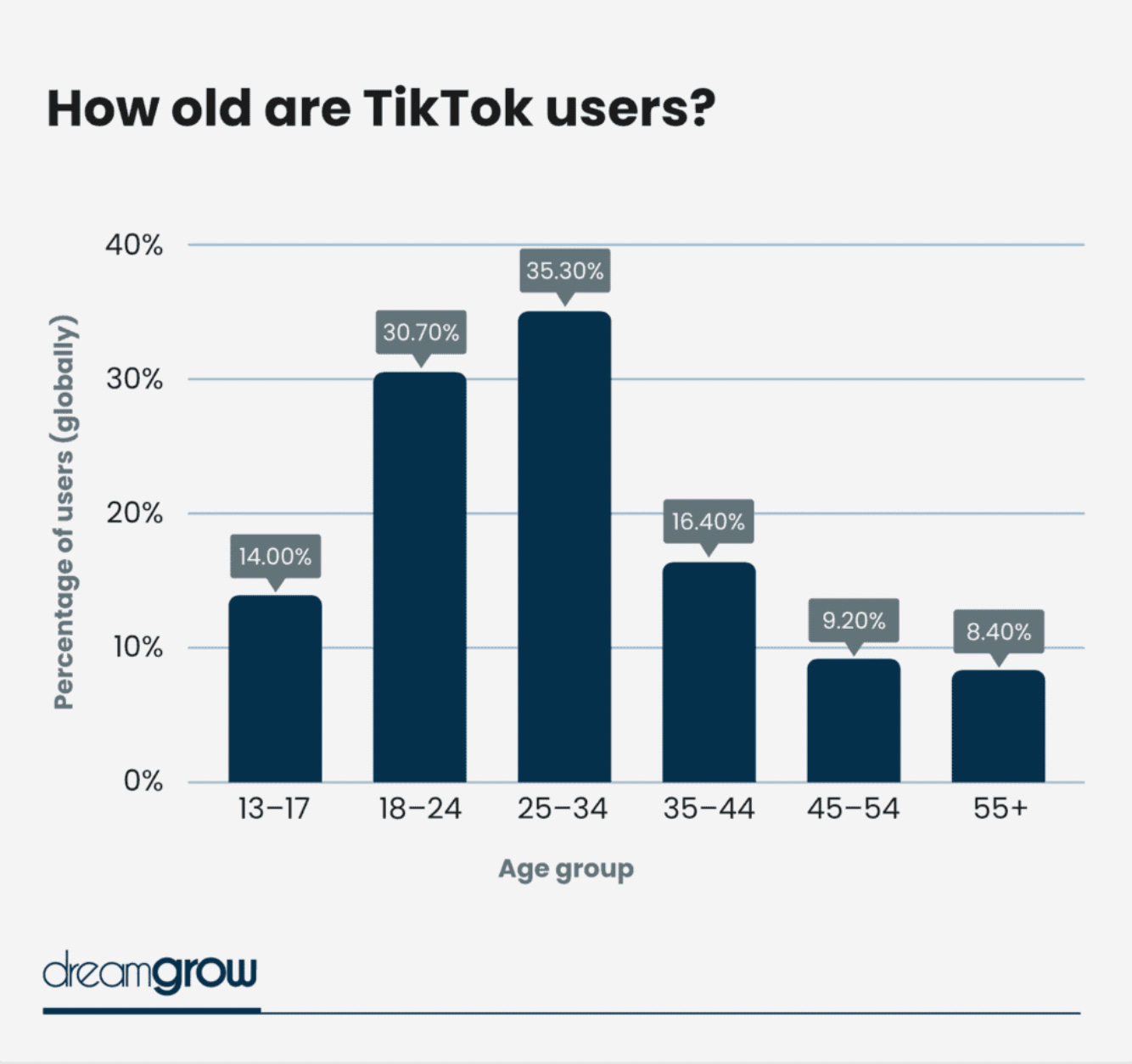
I saw this last month when I was running Meta Ads for a travel app focused on 50yo+ users, delivering a CPI of $3–5 in the US. Then I was told to test TikTok, following the same campaign setup and using the same creatives, but this time I was getting a CPI of $20–25.
💎 For social apps targeting emotional needs, emotion-led hooks (”when I feel sad/lonely/tired”) paired with ultra-short 6-8 second videos dramatically outperform generic content. High retention on short videos signals strong resonance and feeds the algorithm, compounding organic reach.
(12:26) by Anastasiia
This is the huge difference that most of marketeers ignore when testing TikTok: You can’t re-use the creatives that work well in Meta all the time, because TikTok works in a completely different way when it comes to distributing the videos and how the users react to them.
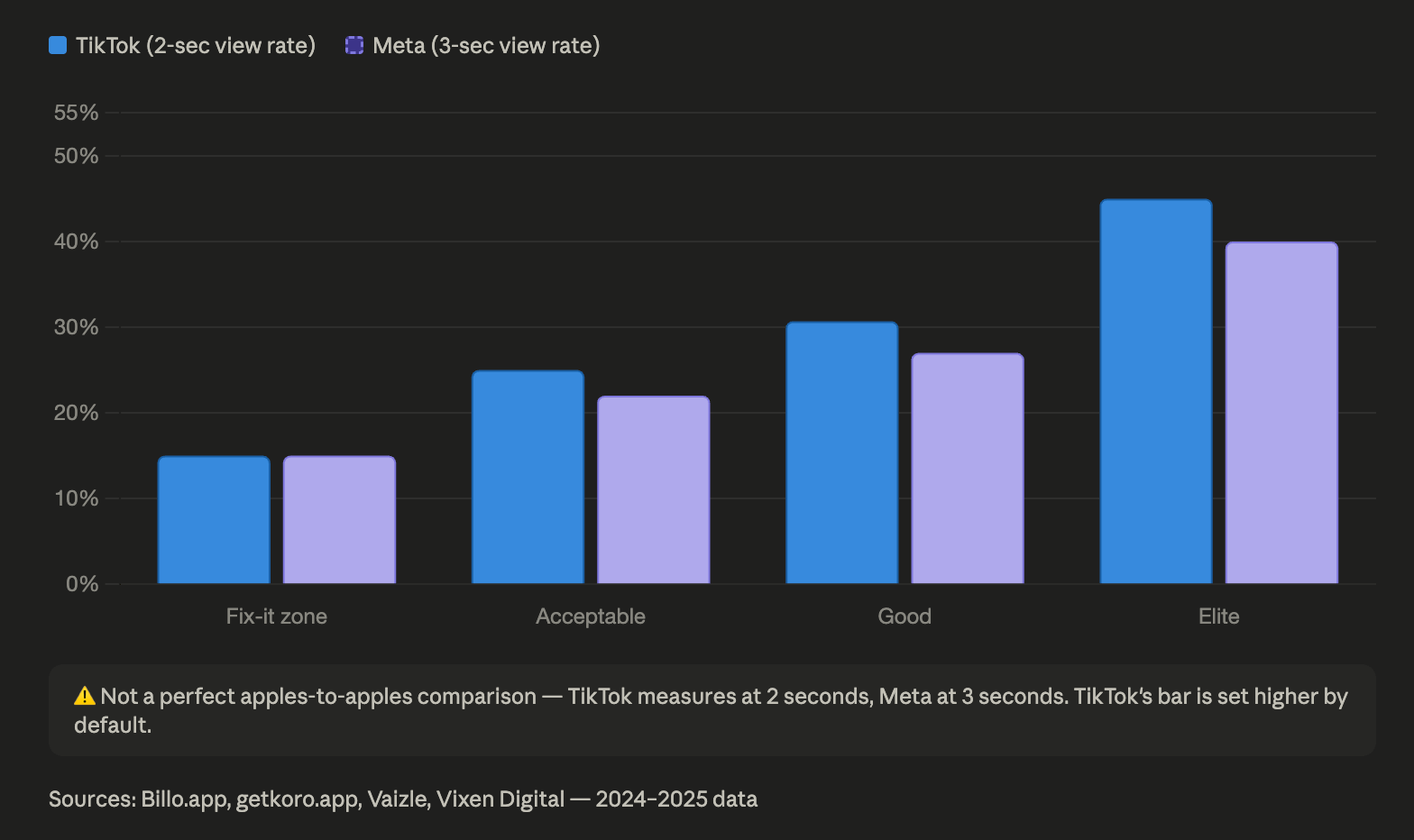
TikTok is a social media platform where scrolling is the core of its usage, something which does NOT happen on Meta, where your main placement is the Feed. This behavioral difference drastically changes the way your videos need to capture your target audience's attention.
You can create ads on Meta that are more likely to be distributed in the Feed, where users read and watch content at a slower pace because it's content they actually follow. But on TikTok, even in the "For You" section, you are forced to scroll, shortening the attention span to just a few seconds, which is exactly why hook rate is measured at 2 seconds on TikTok vs 3 seconds on Meta.
This means you have less time to hook users with an ad, and you must be far more effective in those first 2 seconds if you really want to succeed consistently in the platform. At the same time, this also explains why most of content created for Meta don’t tend to perform on TikTok. The context is completely different because the users react to the content in a different way.
💎 Iterating on variations of a winning concept is not a substitute for testing entirely new concepts. Creative fatigue is inevitable, and you must run parallel experiments on fresh angles at all times so you have a pipeline ready before your current winner dies.
(14:12) by Anastasiia
💎 Treat every viral spike as temporary by default. Build a daily discipline of asking “what is my backup if this fatigues tomorrow?” This forces a continuous pipeline of new concepts and prevents the painful growth cliff that follows over-reliance on a single winning creative.
(14:46) by Anastasiia
TikTok ads fatigue over days. And that is a reality that many advertisers don’t see or don’t want to accept when running TikTok.
Motion’s same synthesis describes TikTok’s pattern as engagement metrics “dying overnight.” TikTok’s own Smart Creative tool auto-pauses videos showing fatigue signals within the first 3 to 5 days. Search Engine Land’s March 2026 piece argued TikTok’s creative half-life is “shorter than any other platform.” Marpipe’s October 2025 data confirms the same: TikTok and Instagram Stories placements saturate in 7 to 10 days, against LinkedIn’s 4 to 6 weeks.
The mechanism is straightforward. TikTok’s algorithm is optimized to push new content hard so your ad reaches its addressable audience much faster. Meta’s algorithm distributes more gradually because they have more placements to diversify the ads, so the same audience sees the same ad over a longer window. Same asset, same targeting, different wear curve. And you need to adapt your creative production to that curve.
💎 Before investing in TikTok organic or paid, do a competitive audit. If your direct competitors are active on Meta but absent on TikTok, treat it as a signal that the category may not convert well on the platform, and factor that into your channel prioritization decision.
(30:54) by Anastasiia
After analyzing the differences that you can find in the creative side, it is important that before testing TikTok, you really check what your direct competitors do in this channel. And if you don’t see them there while they actively spend on Meta, that can be a clear indicator that the messaging or audience the resonates well in Meta might fail on TikTok.
Using Tools like AppMagic, you can even compare the most used creatives from the same advertiser in TikTok vs Meta so you can analyze the differences in the angles, the hooks and the audiences that each creative try to target.
💎 The virality can sound big, but actually you may not get any money from it, and you will just close the company in a few months with a lot of installs and with zero revenue.
(37:57) by Anastasiia
Anastasiia ends the podcast talking about organic virality and its effect on the revenue of the business and this is a problem that many marketeers can face if they have a creator program running with an intense production of organic videos every day.
The reality is that the virality you can achieve with an organic TikTok video will barely impact revenue in a direct way. I work with teams that consistently hit that virality mark of 50K–100K views in a single day, resulting in millions of views within a week –but the revenue curve never moves in parallel with those views.
The revenue curve only starts to react when views begin to compound into search traffic, and that only happens when view volume stays consistently high month after month.
I’ve seen multiple teams complain about one-off collaborations with big influencers and the little effect they have on business metrics. This happens because a single peak of views in one day will never move the needle consistently enough to impact search traffic for your brand and that search traffic is the main lever that organic videos actually move.
Now, jumping to the other podcast, we have Phil Carter, that also shared great insights on the Sub Club Podcast by Revenue Cat that we can directly connect to the previous topics.
💎 AI has opened a window to create magical first-session experiences that convert users within 30 to 60 seconds. With over 80% of trial starts now happening on day zero (and up to 90% in some categories), your onboarding must deliver immediate value or you will lose that user forever. Invest in AI-powered onboarding that hooks users instantly rather than treating setup as a chore.
(08:03) by Phil
I wanted to bring up how AI has closed the gap between install and conversion, getting users to that valuable action within just a few hours in over 80% of apps. This means marketing strategy now plays a crucial role in connecting that first touchpoint with the user to the final presentation of your product during onboarding.
If both strategies — product and marketing — are not aligned, you will end up acquiring users who get lost during onboarding, never finding the “aha” moment they were expecting after watching that first ad you ran on TikTok or Meta.
💎 AI creative tools can take your paid acquisition from tens of concepts per month to 400-plus, and the benefits go far beyond lower CAC. The faster learning cycle from testing more creatives reveals what messaging resonates with users, which directly informs product roadmap decisions. Treat your creative testing program as a dual-purpose engine for both paid UA optimization and product-market fit discovery.
(39:42) by Phil
Another high-correlated topic to UA and how the creative production systems have drastically evolved towards incredibly fast production machines thanks to AI.
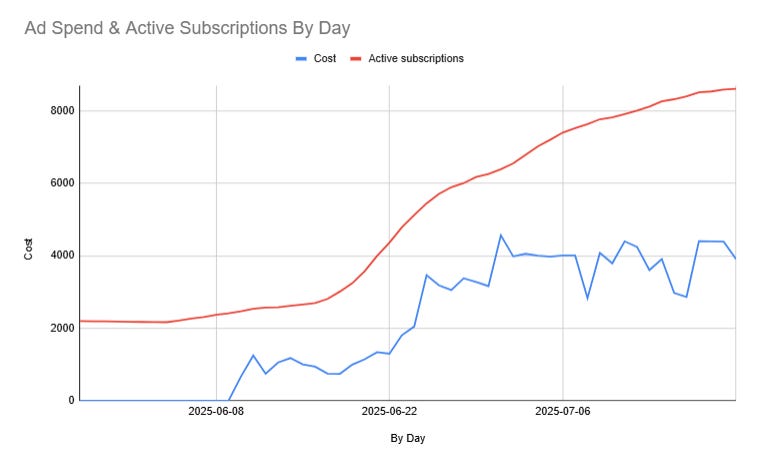
We talked before how TikTok was burning the creatives much faster than Meta ads. In this environment, having AI to leverage the production of new assets increases the ability of marketers to prevent this fatigue in the short and mid term by testing more creatives faster and with more drastic variations in less time.
This is something that I already commented on in one of my articles on RevenueCat, where AI helped me decrease CPA by more than 85% with one single AI video (using an organic trend nobody was using in paid at the time):
💎 AI has fundamentally changed the cost structure of consumer subscription apps, making multi-tier pricing a necessity rather than a luxury. The emerging standard is a basic tier with limited AI access and a premium tier with full AI capabilities, mirroring B2B SaaS pricing models. If you have meaningful AI features, structure your pricing to protect your unit economics while using the basic tier as a funnel into higher-value plans.
(52:30) by Phil
That AI creative I just mentioned had a huge impact in our revenue because we also offered a really attractive introductory offer in the onboarding. But as we expected, that aggressiveness with the price had a cost in the LTV, which got obviously worse although it was still enough to cover the incredibly low CPA that we could get.
However, there was one variable we had not accounted for: how the message of that ad directly impacted token consumption among users coming from that video. A cost that forced us to remove the introductory offer, build a paywall with 9 pricing tiers, and add stricter AI usage limits, all while keeping some options attractive enough from a pricing standpoint so we could still leverage on these good performing AI videos.
💎 AI apps face a unique trial design challenge: longer trials convert better but can be financially catastrophic when power users rack up massive compute costs and then churn. The industry trend toward shorter trials is being driven by AI cost economics, not conversion data. Carefully model your AI compute costs per trial user before setting trial length, and consider capping AI feature usage during trials rather than simply shortening them.
(55:44) by Phil
The problem with the free trials on AI apps that run UA in channels like TikTok or Meta and optimize their campaigns towards this event is that algorithms don’t take into account trial conversion and just optimize on maximizing the volume of trials started.
This results in many users that just start the trial to use the app for free and see what’s behind the paywall but they never subscribe. These non-paying users will likely make use of all the tokens during the trial, increasing your computing cost while and shortening the LTV of the real subscribers that end up converting.
So before launching any UA campaign, run a thorough analysis of your AI compute costs against your pricing strategy and conversion rates, then calculate your target CPA with those costs already baked in. Sometimes you will need to rework your entire pricing strategy or shift your campaign optimization toward more down-funnel events to make the numbers work. Look at the available levers you can use to adjust the numbers while connecting your product and marketing strategy.

Thank you for reading, and I hope you enjoyed these gems mined by David!
See you next time.
Stay curious!
— Sylvain
Chief Insights Miner at Growth Gems ⛏️
(Fractional) Head of Growth at Reading.com
Growth Consultant/Advisor for high-potential subscription apps
Now also growing my own app
🔗 Source:
How One Offline Event Turned into 4 Million online views on RevenueCat’s SubClub podcast
How to Win with Offline Marketing for a Mobile App on The Mobile User Acquisition Show