
Gems from Alper Taner (Head of Performance Marketing) in Creative Testing, Data-Driven Decisions, and Growing Mobile Apps on the Sub Club podcast by RevenueCat
Hi, fellow growth practitioner!
This week, I’m bringing you insights on Creatives and Paid UA.
🥇 TOP GEM OF THE WEEK

SPONSORED RESOURCE & INSIGHTS
The subscription app world’s favorite report is back with its 2026 edition.
Of course, it’s impossible not to compare your app to your category’s benchmarks.
But if you want an edge, you’ll dissect the data and ponder the expert insights to challenge your strategy and roadmap…while keeping in mind your own context.
You’re busy, focused on your app and the day-to-day.
But ignoring this kind of input would be insanity.

Last but not least, this year’s edition comes with some bonuses: several Sub Club “Minisodes” and exciting courses in the FREE StartApp School RevenueCat just launched. I can’t wait to dive into these!
P.S. One piece of advice: pay attention to the terms and their definitions: how RevenueCat measures things, what’s a “hard paywall” in the report, a promotional offer, a discount, etc.
Who doesn’t look at what competitors do?
Or challenge what they’re doing when a growth expert shares an insight?
That’s healthy. Needed. But some take it too far.
So today I’m sharing gems from Alper on challenging best practices and testing hypothesis the right way.
💎 Don’t label metrics as ‘problematic’ until you’ve systematically tested and iterated on solutions to improve them. Focus on understanding ‘why’ before declaring something broken.
Example: a low conversion rate is just a fact until you’ve diagnosed the root cause, created an action plan, and measured results.
(06:31)
You can’t look at metrics in isolation. Even when you’re getting a health score with several metrics like what RevenueCat provides, it doesn’t tell the full story. Are you focusing on organic socials? Acquiring a particularly older audience on Meta? What’s your pricing? You need to understand the full funnel, and break down metrics by main segments.
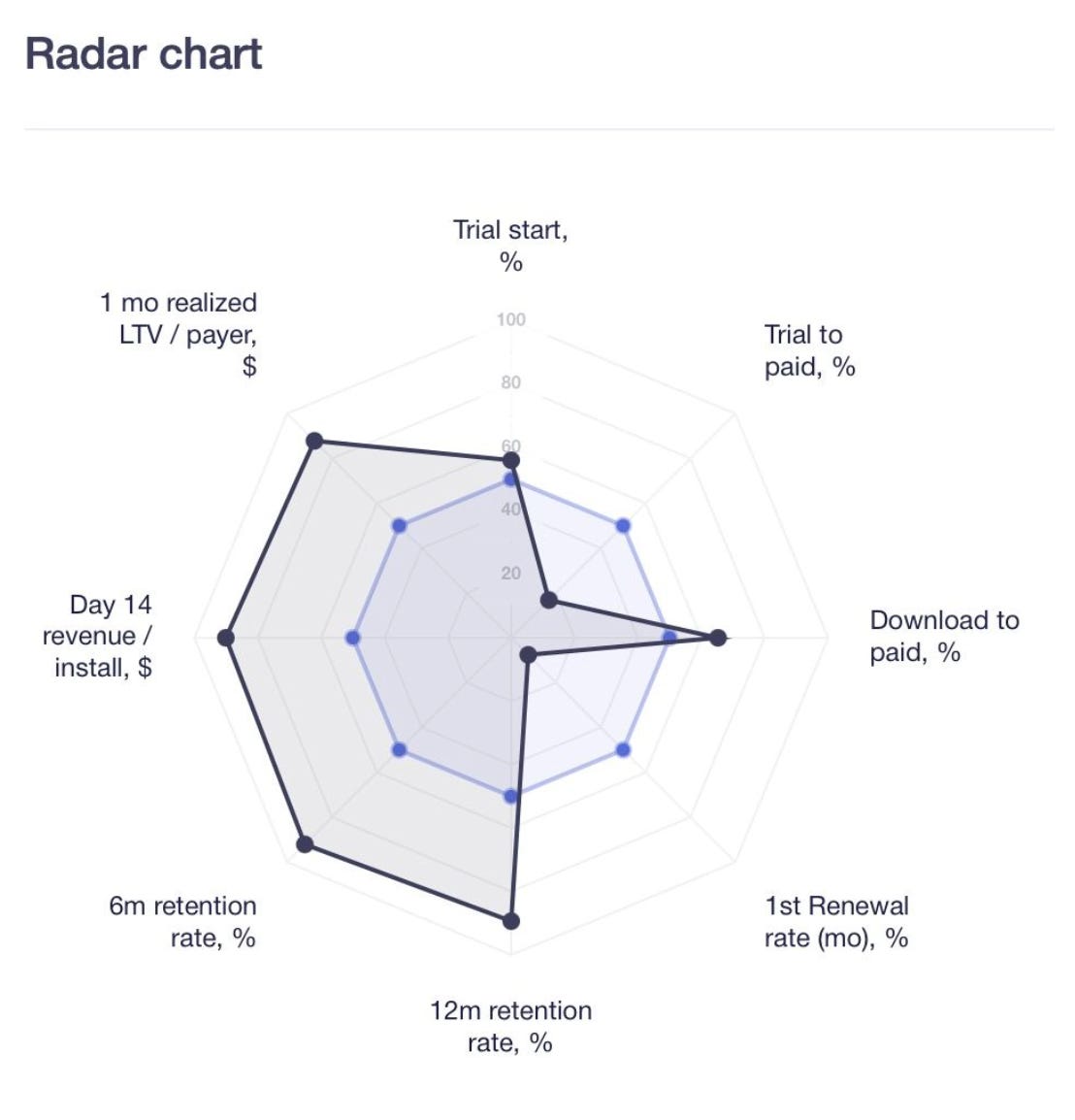
💎 Take the time to test your hypotheses properly (with adequate spend, duration, and variations) because premature conclusions waste more resources than thorough testing.
(07:57)
This reminded of a few different gems around the “Minimum Viable Test” I shared in the past. Check out the corresponding LinkedIn post below.

💎 In creative testing, quality of learning beats quantity of test. Creative strategy is about forming hypotheses and learning what works or not, and why.
(12:20)
You still need to test a concept with a few variations! He’s seen the 3rd variation of a concept win after the first 2 variations had failed.
But his overall advice there is to optimize for faster learning per creative tested rather than creative volume.
💎 The real KPI of a creative testing system is cost per successful creative, not the number of creatives tested.
(14:15)
That's an interesting thought, but I don't think that's true in all instances: for example if you're spending 1 million per month, whether it costs you $1k, $10k or $20k to produce and find a winning creative doesn't matter that much.
Alper’s counterpoint:
“if your Cost per successful is going up over time, something is likely wrong with the setup. I think it matters, its always about efficiency. Absolute number might not matter, decreasing over time matters.”
While we’re on the topic of creative hit rate, I also recommend the brand-new Motion’s Creative Benchmarks report (D2C focused but a great read!).
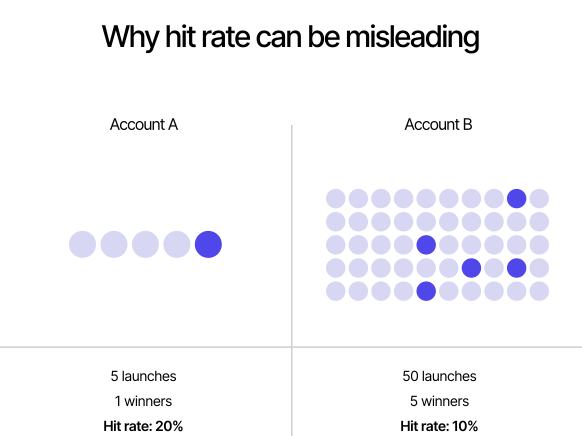
💎 When a company is testing a high volume of creatives, the level of detail and quality to shape the next input is sometimes jeopardized.
(16:17)
Very good point. With the increased creative production volume (because you’re scaling and because of AI), it’s easy to just categorize based on down funnel performance and fall into the trap of testing and throwing away anything that doesn’t work.
💎 Determine your creative testing spend threshold, find your account-specific decision point by analyzing when cumulative spend and CPX metrics stabilize. This prevents both overspending on bad creatives (wasting 10K+ when $500 would suffice) and underspending on potentially good ones.
(17:08)
As you think about this, you might want to play around with NewForm’s Creative Production Calculator (corresponding post here) and AdManage’s Ad Creative Calculator.
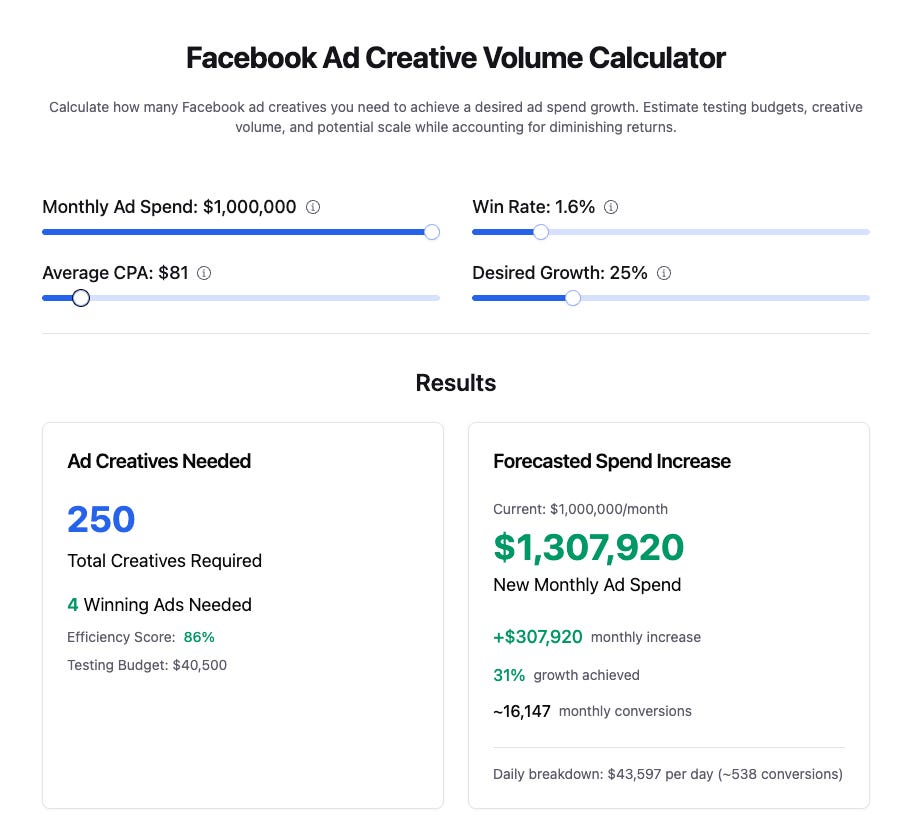
💎 Don't assume creatives that get less algorithmic spend are bad: they may just be unlucky in the initial 5-10K impressions. When one creative dominates 90% of spend, pause it and give other creatives equal opportunity. The algorithm's early decisions aren't always optimal.
(18:11)
It’s an interesting point, that reminded me of a gem by Thomas Petit in Growth Gems #129:
💎 The worst you can do is force spend on every single ad. This approach wastes significant budget on ads that platforms won’t naturally deliver to. Let the platform’s delivery preferences guide your testing allocation.
My take: you have to find the right balance.
Like Alper, I’ve paused an ad getting most spend and noticed several other ones in the ad set starting do well. But I disagree about the “equal opportunity” because:
Eventually ads will compete with others (that have historical data)
True winning ads are fairly easy to spot
I also don’t like to pause an ad that is performing well because once you graduate it to BAU you might not see the same performance (even when keeping the creative ID and social proof).
💎 Merge multiple data sources for creative hypotheses: Meta performance data, in-app analytics showing what high-LTV users engage with most, competitor concepts, trending formats, and category-level inspiration. Don't rely solely on ad platform data: your best creative ideas may come from understanding what retains users.
(26:00)
💎 Use Meta Ad Library strategically: if a competitor has 15+ variations of one concept versus 2-3 of others, it's likely a winner they're iterating on. But treat this as inspiration only because their success doesn't guarantee yours due to different audiences, funnels, and positioning.
(28:02)
If you look up competitor ads by Facebook page, I’ll also let you in on a little secret: you’re not seeing all their ads…
💎 Never just copy what a competitor does or what a best practice indicates. These might inspire variants in your testing roadmap, not be copied one-to-one. Different audiences, funnels, pricing, and messaging mean their winning creative or paywall may fail for you (or not be optimal).
(29:57)
David mentioned the tweet below by Vahe…

💎 Match your measurement tool to your question: use MMP for creative comparison, but use incrementality testing (geo-lift, holdouts) for channel comparison.
Example: Google UAC’s search intent makes it appear cheaper in last-click attribution, but that doesn’t reflect true incrementality.
(34:00)
It comes down to looking at multiple sources of data. Even for creative comparison, you need an understanding of the down-funnel performance.
💎 When algorithms overspend your daily budget while maintaining or improving performance, lean into it aggressively. This signals untapped demand and you can often scale 5x in weeks by ignoring conservative 20% daily increase rules and letting performance guide spend.
(40:31)
Especially during high seasonality, being too conservative will lead to a missed opportunity. Ryan Thorpe was talking about how much/fast they scaled in January, disregarding the “small increments” rule 👇

💎 Test extreme budget strategies, but with proper guardrails: set campaign-level budgets to $1M/day (to eliminate pacing constraints) while using campaign spend limits and bid/cost caps for control. This can unlock higher-quality traffic by removing artificial pacing limitations. Only do this if you have a large account, a lot of learnings, and the proper monitoring in place.
(42:16)
He shared this allowed to capture a lot more high-quality traffic.
💎 Event mapping can dramatically impact performance, both ways.
Example: in one case, switching from mapping start trial from 'purchase' to 'trial' reduced cost per trial by 35% in one case. When your trial value ($10-15) can't compete in auctions with e-commerce brands bidding $200 for purchases, optimize for trial instead to access different inventory and lower CPMs.
(55:29)
I'm sure in this case this didn't happen, but the risk is to get exactly what you ask for: a lot of trials. Problem is, trial conversion might go down.
A word of caution from Alper: don’t go changing your setup if things are good! All your account learnings are based on what you’ve ran so far. There’s no one right setup for every app.
💎 Maintain logical funnel consistency in event mapping: don't send mixed signals like mapping 'subscription cancellation' to 'add to cart.' Algorithms optimize based on typical user behavior patterns, and illogical event mapping confuses the machine learning, reducing delivery confidence and auction competitiveness.
(56:51)
He shared that if your funnel looks completely different to Meta to all the other advertisers, the algorithm will struggle to perform.
This is often overlooked, particularly when advertisers use custom events.

See you next time.
Stay curious!
— Sylvain
Chief Insights Miner at Growth Gems ⛏️
(Fractional) Head of Growth at Reading.com
Growth Consultant/Advisor for high-potential subscription apps
Now also growing my own app
🔗 Source:
Creative Testing, Data-Driven Decisions, and Growing Mobile Apps on the Sub Club podcast by RevenueCat